

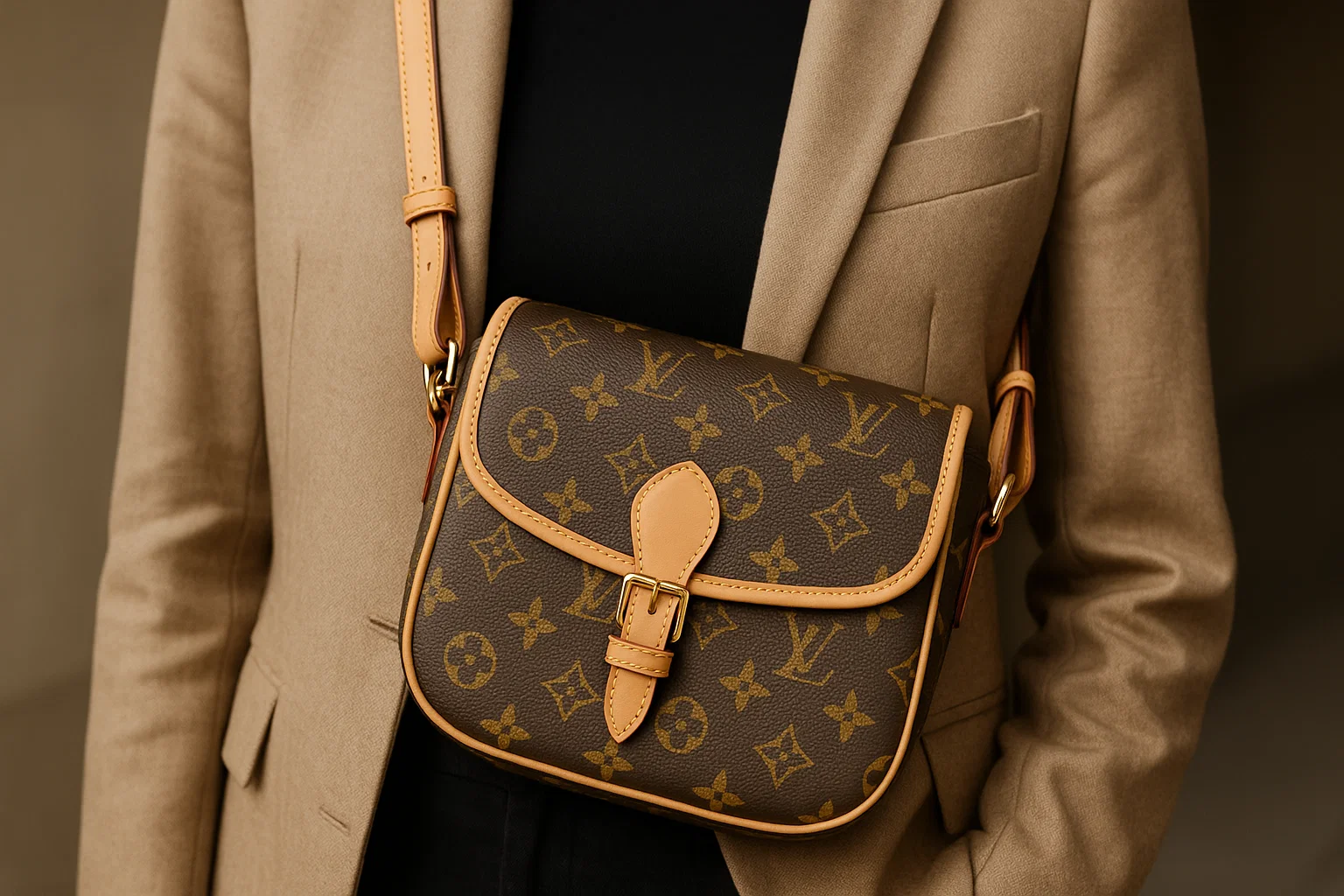
Desire used to move in whispers. Now, it leaves traces — in clicks, pauses, and scrolling patterns that quietly map what we want. Somewhere in that data, the Louis Vuitton crossbody bag began to behave differently. While trends rise and vanish, it stayed—steady, almost alive.
This isn’t just a story about fashion. It’s about how luxury learned to move with algorithms, how visibility replaced rarity, and how desire itself became measurable. In the patterns Mira studies, beauty and data overlap until they’re almost indistinguishable — proof that in the age of endless refresh, even longing can be optimized.
Table of Contents
A Quiet Pattern in the Data:Where Desire Begins to Behave
Mira doesn’t spend her days at fashion shows or in design studios.Her office hums softly—screens glowing,numbers sliding across them like restless tides.She studies dashboards full of motion:clicks,pauses,dwell times.Each figure marks a small pulse of curiosity somewhere out there,tiny traces of modern longing hidden in data.
Trends usually follow rules.They rise,flatten,fade.But one curve refused to fade.It dipped,looped,and climbed again,defying the logic that governs digital fatigue.
That product was the Louis Vuitton crossbody bag.
Across markets and moods,it behaved the same—steady,resistant to boredom.Mira found herself watching the data the way one watches a heartbeat,drawn to its persistence.
When she shared the results,someone joked,“So it’s self-aware now?”
She smiled.“Maybe it just listens better than the rest.”
That night she couldn’t stop thinking:what if objects really could learn to move with us,like code responding to new signals?The numbers didn’t prove it,but they whispered something close—a pattern that almost felt alive.She closed her laptop and sat still,letting the low hum of the machines blur into her breathing.
How Luxury Learned to Behave Like Code:The Algorithm Behind Taste
Luxury once meant time:the slow rhythm of handwork,waiting lists,secrecy.Today,speed writes the rules.If it can’t be found or shared,it barely exists.
Brands now function more like tech firms than ateliers.They iterate,track feedback,patch their image.“Luxury’s gone agile,”Mira tells colleagues.“We don’t launch products—we roll out updates.”
Inside those cycles,data leads.A design that performs well online returns faster.A material that doesn’t spark engagement quietly disappears.Designers talk about user experience alongside craftsmanship.
Shapes with clear geometry,logos easy for both eyes and algorithms to read—those win the visibility game.The system amplifies what it recognizes.People follow what they keep seeing,until repetition feels like trust.
Mira isn’t cynical about it.“Luxury didn’t lose its soul,”she says.“It just learned a new language—the language of platforms.”
And in that new language,aesthetics follow function:beautiful things survive because they can keep up.In meetings,she sometimes feels the room hold its breath between numbers and intuition.It reminds her that behind every metric is someone trying,quietly,to make meaning out of noise.
The Social Mirror:How Visibility Replaced Ownership
Every morning,Mira scrolls the feeds she studies for work.The repetition is soothing in a strange way.Different people,same poses.Mirror selfies,street corners,cafe light.Every post trying to feel spontaneous,every one following the same invisible draft.
“The algorithm rewards proof,”she says.“Not ownership—proof.”
Owning is no longer the goal.Belonging is.The Louis Vuitton crossbody bag sits right at that intersection.Its proportions make it easy to stage—a shape that fits the hand and the frame equally well.
Mira calls it aspirational mirroring:a rhythm between seeing and being seen.Someone posts an image; someone else copies the pose.Over time,imitation starts to feel like participation.
She maps out engagement clusters and sees how the same symbol reappears,traveling between continents but staying visually identical.At some point,it stops being personal—it becomes cultural shorthand.
“People don’t buy the thing,”she tells a friend. “They buy the right to be in the picture.”
Sometimes she catches her own reflection while scrolling and wonders when watching turned into wanting—how curiosity slides into envy without her noticing.
The Half-Life of Desire in the Age of Constant Refresh
The data,as always,is merciless.Two weeks after most purchases,online conversation drops to near zero.The celebration fades before the product even leaves its dust bag.
Mira calls it the half-life of satisfaction.
Brands fight the decline by releasing faster:new colors,new collaborations,minor variations.It’s not manipulation,she argues—it’s maintenance.The system has no patience for stillness.
But even that rhythm has limits.“There’s only so much novelty a person can feel,”she says.“After a while,new just feels noisy.”
And yet a few designs seem immune.They last not by staying still but by reappearing in new contexts—on new shoulders,in new cities,under slightly different light.
“Timelessness,”she writes in a note to herself,“isn’t about resisting change.It’s about knowing when to move quietly enough that no one sees you move.”
Later,walking home,she pauses at a bus stop ad showing a familiar bag against an unfamiliar slogan.The detail shifts,but the message stays.She feels a quiet ache—the strange fatigue of chasing something designed never to rest.
Owning Without Touching:The Rise of Virtual Luxury
Over the past year,Mira has watched the industry drift somewhere unexpected—toward the sale of things that don’t exist physically at all.Digital handbags,NFT accessories,metaverse runways.
She studies the metrics.NFT resale charts,gaming partnerships,3-D collaborations.The numbers look real because they are.
When a virtual version of the Louis Vuitton crossbody bag launched online,engagement curves matched the physical release almost perfectly.Screenshots replaced photos,but the emotion traced the same line.
“Turns out people want the symbol,not the object,”she says quietly.
It makes a certain sense.Digital luxury removes friction:no waiting,no storage,no guilt.Visibility without the weight of possession.
Still,she misses the texture of things.The soft grain,the slight unevenness where a craftsman’s hand lingered too long.“Without imperfections,”she writes later,“beauty starts to look flat—like a reflection that forgot what it’s reflecting.”
She closes her eyes and imagines the sound of leather stretching,the faint scent of dye and dust—proof that something real once passed through human hands.
When the System Looks Back:The Observer Becomes the Target
One evening,Mira noticed something odd.Her own clicks had begun showing up in her dashboards.Every image she’d zoomed into,every replayed ad,all neatly recorded under “user activity.”
The algorithm didn’t know she was the observer.To the machine,she was just another potential buyer.
Soon the ads found her:familiar shapes,similar headlines,slightly adjusted tones.They followed her across unrelated pages,subtle but constant.
At first,she laughed.Then she stopped laughing.
Repetition,she realized,creates familiarity;familiarity,comfort;comfort,desire.The machine wasn’t selling—it was reflecting.It held up a mirror until she started recognizing herself in the pattern.
She typed a note into her phone:You can’t study desire without feeling it touch you back.
Later,she used the sentence in a presentation.People called it insightful.She didn’t mention it came from a moment of discomfort,the eerie sense that even neutrality leaves traces.She thought of it later,brushing her teeth,and felt briefly exposed,like the room itself was watching.
The Ethics of Predictability:When Algorithms Define Desire
Luxury used to trade on mystery—scarcity,silence,surprise.Now it thrives on prediction.
Data teams can forecast trends with near-scientific precision:color palettes,emotional responses,drop timings.For executives,it’s efficiency.For Mira,it’s a little terrifying.
“If everything’s predictable,”she says,“curiosity disappears.”
Her reports argue for restraint.Leave some questions unanswered,some flaws unedited.“Perfection reads like automation,”she writes.“Friction reads like truth.”
She points to simple examples:an uneven stitch,a spontaneous photo,a hand rather than a logo in the frame.
That’s why even icons endure—they evolve subtly,letting time mark them.The Louis Vuitton crossbody bag,she notes,changes only in details:a grain variation,a new strap,a different shade under sunlight.Imperceptible to some,reassuring to others.
Predictability may sell;imperfection keeps people interested.Sometimes she wonders if uncertainty,not perfection,is the real luxury—because it lets her feel something genuine,if only for a moment.
The Search for a Slower Luxury:Redefining Value in the Attention Economy
Mira’s newest project feels almost contradictory:teaching algorithms to slow down.Her company calls it ethical optimization—a way to measure not only how fast something sells,but how long it stays meaningful.
The goal sounds romantic,but data supports it.Products tied to craftsmanship and transparency—visible repairs,maker stories—keep emotional engagement longer.“Sustainability,”she tells her team,“isn’t just about materials.It’s about memory.”
Convincing investors is harder.Speed means growth.But creative directors are listening.Some are experimenting with long campaigns,slower storytelling,collections that age rather than vanish.
“Maybe it’s not about speed,”she says during a meeting.“Maybe it’s about rhythm.Even music needs pauses.”
Someone chuckles;no one disagrees.
She walks home through empty streets after midnight,city lights reflecting in puddles like broken code.She feels oddly calm,her breath matching the rhythm of her steps,as if the city has finally exhaled with her.
Understanding Desire After All:What Algorithms Still Can’t See
The city outside her office glows with advertisements.Screens loop promises:newness,transformation,belonging.Mira walks past them without looking,until one storefront stops her.
Behind the glass,under a perfect wash of light,rests the Louis Vuitton crossbody bag—the same product she’s analyzed for years,now just sitting there,quiet and self-assured.
She stands for a moment,unsure what she feels The data she’s studied suddenly feels irrelevant.No metrics,no graphs,just an object and the space it holds.
Desire,she thinks,isn’t built by machines.It’s only measured by them.The real thing—the spark that keeps people reaching—lives somewhere data can’t see.
She types one last note on her phone:
Maybe luxury lasts because it reminds us how to look,even when we’ve stopped buying.
It isn’t a conclusion,just a thought.And maybe that’s better.Some ideas,like desire itself,work best when they’re left a little unfinished—when silence fills the space that numbers can’t.She turns away,feeling the city’s brightness soften into something almost kind.
Read Also: Understanding the Inpatient Revenue Cycle and Its Role in Healthcare Success